

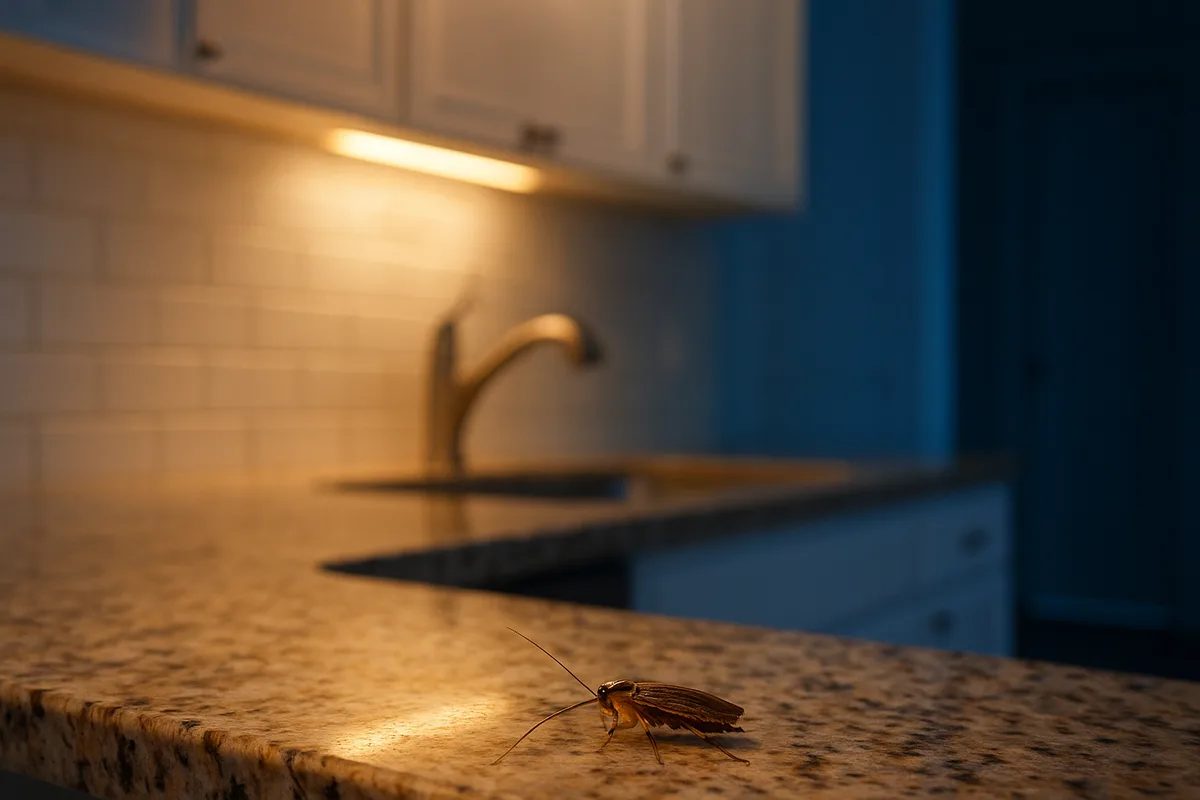
How to Get Rid of Cockroaches in Your Dallas Home
To get rid of cockroaches in your house, identify the species first, then treat accordingly:
- Identify the species. Small tan roaches with two dark stripes behind the head are German cockroaches — they breed indoors. Large reddish-brown roaches 1.5–2 inches long are American cockroaches (“water bugs”) — they enter from outside and do not nest in your walls.
- Stop using contact spray. Spray scatters German cockroaches deeper into wall voids and does not kill the egg capsules, so the population rebounds.
- Apply professional gel bait in cracks and crevices — under sinks, behind and beneath the refrigerator, inside cabinet hinges, and along the back edge of countertops. Small dots in many places beat a few large ones.
- Add an insect growth regulator (IGR). This stops hatching nymphs from reaching breeding age and is what prevents the rebound at week three.
- Remove water sources. Fix drips, dry out sinks at night, and empty pet bowls. Cockroaches survive weeks without food but only about a week without water.
- Seal entry points — floor drains, pipe penetrations under sinks, door sweeps, and garage door gaps. For American cockroaches, this is the treatment.
- Re-bait at two weeks. Expect a visible drop in 7–10 days; full elimination of a German cockroach infestation takes 4–8 weeks.
If roaches are still active after two rounds of bait, or you are in an apartment where neighboring units are untreated, the population is being fed from outside your unit and needs a professional building-wide program.
Below: how to tell the two species apart, why DIY sprays usually make things worse, and exactly how professionals bait.
Want the full picture on Texas pests? Read our General Pest Prevention Guide for a complete overview.
Two Very Different Problems: American vs. German Cockroaches
The cockroach treatment approach depends entirely on which species you have. Getting this wrong is the most common reason DIY treatment fails.
American Cockroach (the “Water Bug”)
- Appearance: 1.5–2 inches long, reddish-brown, oval-shaped
- Where they live: Sewers, drains, storm drains, and outdoor harborage
- How they enter: Through floor drains, under exterior doors, through pipe penetrations and utility gaps
- Behavior: They come inside seeking moisture or food, but they don’t live and breed indoors the way German cockroaches do
Treatment goal: Seal entry points and maintain a perimeter barrier. American cockroaches are an entry problem, not a nesting-inside-your-walls problem.
German Cockroach
- Appearance: 1/2–5/8 inch long, tan with two dark stripes behind the head
- Where they live: Inside — kitchen cabinets, under sinks, behind appliances, inside wall voids
- How they enter: Brought in on grocery bags, cardboard boxes, secondhand appliances, or infested items
- Behavior: They breed indoors. A single female can produce hundreds of offspring. An infestation grows exponentially.
Treatment goal: Eliminate the breeding population inside the home. This requires gel bait, not sprays.
Why Cockroach Sprays Often Make Things Worse
Walk into any hardware store and you’ll find dozens of cockroach sprays. They smell strong and kill roaches on contact. So why do so many people spray for weeks with no lasting results?
Sprays repel, not eliminate. Contact spray kills individual cockroaches that touch the treated surface, but it also repels the rest of the population — scattering them deeper into wall voids, behind appliances, and into neighboring units (in apartments). You kill a few but push the others out of reach.
Sprays don’t reach nesting sites. German cockroaches nest deep inside wall voids, inside appliances, and inside cabinetry where sprays can’t reach.
Sprays don’t affect eggs. Cockroach egg capsules (oothecae) are resistant to most contact insecticides. Even if you kill every visible cockroach, eggs hatch and the population rebounds.
Resistance. German cockroaches have developed significant resistance to many of the active ingredients in over-the-counter sprays. In some DFW populations, spray treatments are largely ineffective.
The professional approach — gel bait placed in crack-and-crevice locations — works completely differently.
What Actually Works: Gel Bait for German Cockroaches
Professional-grade gel bait (like Advion, Maxforce, or Alpine) is the gold standard for German cockroach treatment. Here’s why it works:
- Cockroaches are attracted to it — Bait is formulated to appeal specifically to cockroaches. They actively seek it out.
- They eat it and die — The active ingredient works after ingestion, not on contact.
- Secondary kill — Cockroaches that eat bait excrete it, and other cockroaches eat the excrement and also die. Dead cockroaches are cannibalized, spreading the effect through the population.
- No repellency — Because bait isn’t a spray, cockroaches aren’t scattered. The population is drawn to treatment rather than away from it.
Where bait is placed: Inside cabinet hinges, under and behind appliances, inside wall switch and outlet boxes, under sink drain areas, inside electrical boxes, and in any crack or void where cockroach activity is present. Placement matters enormously — bait in the wrong location won’t be found.
Step-by-Step: Getting Rid of Cockroaches
Step 1: Identify the Species
Is it a large reddish-brown cockroach (American/water bug) or a small tan cockroach (German)? Your treatment plan depends on this.
Step 2: Eliminate Food and Water Sources
- Store all food in sealed airtight containers
- Empty trash daily; use bins with lids
- Wipe down grease around burners and range hood
- Fix dripping faucets and leaks under sinks
- Wash dishes before bed or at minimum rinse and stack them
- Remove pet food and water bowls overnight
Step 3: Reduce Clutter and Harborage
Cockroaches love cardboard — it mimics tree bark and provides warmth and shelter. Remove stacks of cardboard, paper bags, and old newspapers from cabinets and closets. Clear under-sink areas of clutter.
Step 4: Seal Entry Points (Critical for American Cockroaches)
- Seal gaps around pipes entering through the kitchen and bathroom cabinets with foam or silicone
- Install drain covers on floor drains
- Check door sweeps on exterior doors for gaps
- Seal around utility penetrations through exterior walls
Step 5: Apply Treatment
- American cockroaches: Exterior perimeter barrier spray + entry point sealing + drain treatments
- German cockroaches: Gel bait placed in all harborage points + monitor with glue boards
Step 6: Monitor and Follow Up
German cockroach infestations typically require two to three treatments over four to six weeks to fully eliminate. Population reduction is visible after the first treatment, but follow-up is critical to catch the next hatch cycle.
When to Call a Professional
Call a pest professional if:
- You have German cockroaches — DIY bait products exist, but placement expertise and professional-grade formulations make a significant difference in speed and completeness of elimination
- You’ve treated with sprays and the problem persists — Stop spraying and call a professional; continuing to spray repels roaches without eliminating them and makes bait treatment harder
- You’re in an apartment — Cockroaches from neighboring units require building-wide treatment coordination
- The infestation has spread to multiple rooms — A widespread population needs systematic, thorough treatment beyond what most homeowners can do alone
Preventing Cockroaches from Coming Back
Once you’ve eliminated an infestation, these habits keep it from returning:
- Inspect groceries — German cockroaches frequently hitchhike on grocery bags and cardboard boxes. Unpack groceries promptly and discard cardboard.
- Inspect secondhand appliances — Used microwaves, toasters, and refrigerators are common sources of German cockroach introductions.
- Maintain quarterly pest control — A professional barrier treatment every 90 days prevents American cockroaches from entering and catches any German cockroach activity early.
- Don’t let dishes sit overnight — Even a rinsed plate with food residue provides sustenance for cockroaches.
- Keep the kitchen dry — Fix any dripping faucets immediately; cockroaches need water to survive.
FAQ: Cockroaches in Dallas
Are cockroaches dangerous?
Yes. Cockroaches carry Salmonella, E. coli, and dozens of other pathogens on their bodies and in their feces. They contaminate food prep surfaces and trigger asthma and allergy symptoms, especially in children. Cockroach allergens are a leading cause of childhood asthma in urban areas.
I see one cockroach — does that mean I have an infestation?
For American cockroaches (the large ones), seeing one or two doesn’t necessarily mean an indoor infestation — they may be wandering in from outside. For German cockroaches, seeing even one during the day is a warning sign of an established population. German cockroaches are nocturnal; if they’re visible during the day, the hiding spots are overcrowded.
How long does it take to get rid of German cockroaches?
With professional gel bait treatment, you’ll typically see a 90%+ reduction in 3–4 weeks. Full elimination usually takes 6–8 weeks with two to three service visits. This assumes the source of the infestation (entry route or neighboring unit) is also addressed.
Is cockroach gel bait safe around kids and pets?
Professional gel bait is applied in tiny amounts (pea-sized dots) inside cracks and crevices where children and pets can’t access. When applied correctly by a licensed technician, it poses minimal risk.
Why do I have cockroaches if my house is clean?
American cockroaches come from sewers and don’t require an unsanitary home — they’re simply following plumbing into your house. German cockroaches are most commonly introduced through contaminated items (grocery bags, used appliances, deliveries) rather than being attracted from outside by dirt or mess.
Ready to Be Cockroach-Free?
Top Spot Pest Control provides professional cockroach treatment throughout the Dallas-Fort Worth area. We’ll identify the species, find where they’re coming from, and apply the right treatment to eliminate them — not just scatter them.
Schedule a Cockroach Treatment or call us today. We serve Dallas, Plano, Garland, Mesquite, Irving, Richardson, and surrounding DFW communities.